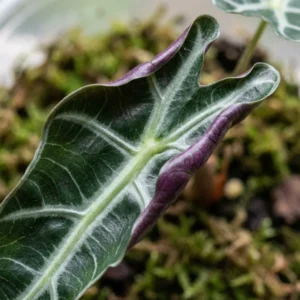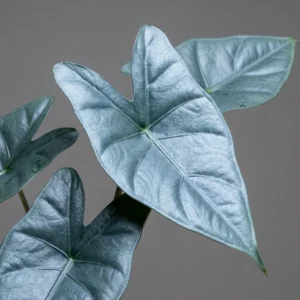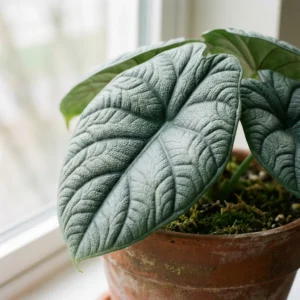
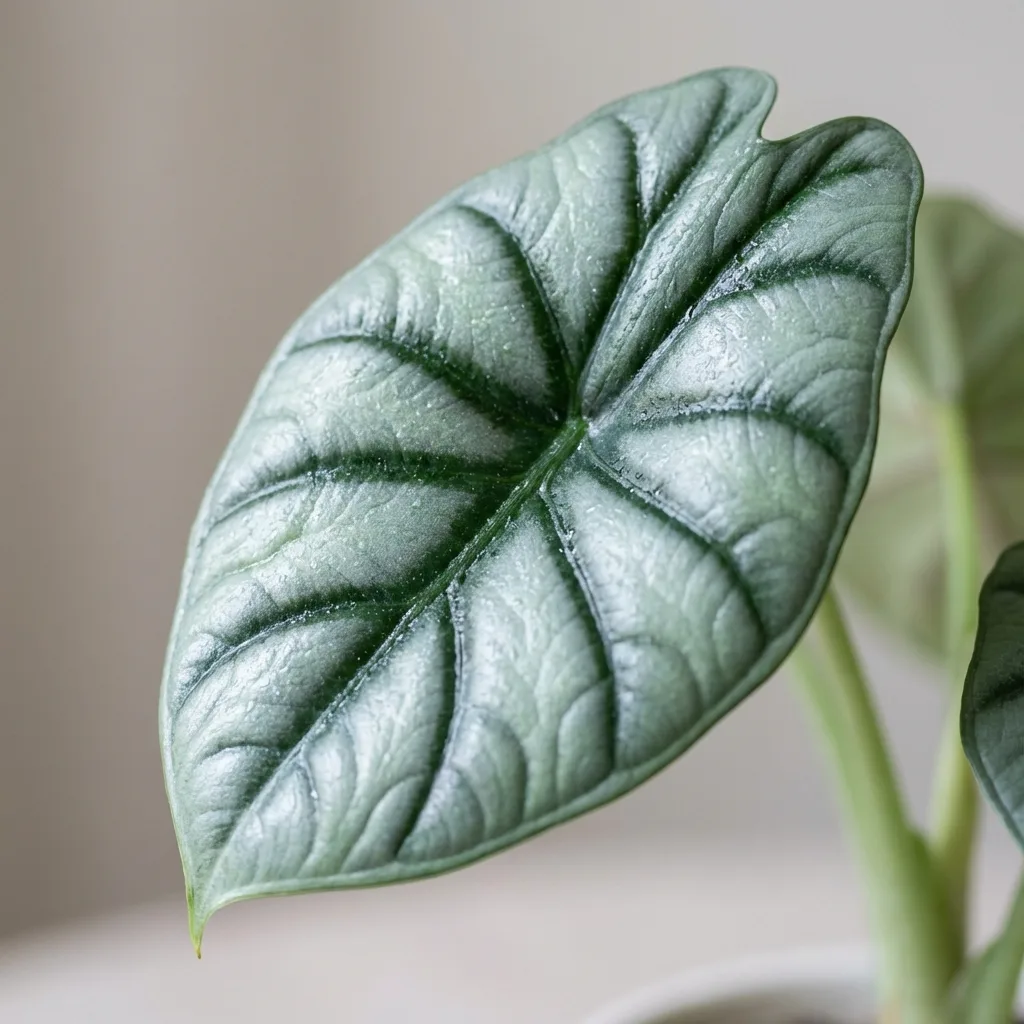
Most Alocasias follow a pattern: Dark leaf, light veins (like the Polly or Frydek). The Alocasia Reversa looked at that rulebook and threw it out the window. True to its name, this Jewel Alocasia features a silvery-blue leaf with dark charcoal veins, creating a stunning “reverse” variegation effect. It’s small, it’s rebellious, and—fair warning—it’s a bit dramatic.
The Alocasia Reversa is a slow-growing Jewel species from Borneo. It thrives in medium indirect light and high humidity (60%+). Unlike the larger species, it is extremely prone to root rot. Use a rocky, airy soil mix and water only when the top 75% of the soil is dry. It stays compact (under 12 inches), making it perfect for terrariums.
Jump to Sections
ToggleWhy “Reversa”?
The name isn’t just a marketing gimmick. In the wild, this pattern helps the plant camouflage against dappled light on the forest floor. The “Reversa” effect (dark veins on light background) is rare in the Alocasia genus, which usually sports light veins on dark backgrounds.
Growth Habit: It is a true dwarf. If you are waiting for it to become a giant floor plant, you will be waiting forever. It tops out at about 10-12 inches.
Finding the Sweet Spot
The Reversa is sensitive to bleaching. Because the leaf is already light (silvery-blue), too much light will wash it out completely to a ghostly white/yellow.
Recommendation: Place it 3-4 feet away from a window, or under a grow light set to 50% intensity. It prefers “dappled shade” simulation.
Soil: The Rockier, The Better
We say this for all Jewels, but for the Reversa, it is non-negotiable. Its roots are incredibly fine and rot faster than you can say “overwatered.”
The 70/30 Mix
- 3 Parts Pumice/Perlite/Lava Rock
- 1 Part Orchid Bark
- 1 Part Coco Coir
Notice how little “soil” is in there? That’s the point. It needs air pockets more than it needs dirt.
Watering The Rebel
The Golden Rule: When in doubt, don’t water.
The Alocasia Reversa stores water in its thick petioles. Squeeze the petiole gently (very gently). If it’s firm, it doesn’t need water, even if the soil is dry. If it feels slightly soft or pliable, it’s time for a drink.
💡 Pro Tip: Bottom watering is excellent for Reversa. It encourages the roots to grow down searching for water, rather than keeping the sensitive collar (where stem meets soil) wet.
Humidity & Terrariums
Because of its small size and high humidity needs (70-80%), the Alocasia Reversa is the ultimate terrarium plant.
Inside a glass dome or cabinet, it becomes almost maintenance-free. The constant humidity keeps the leaves pristine and prevents the dreaded “crispy tips.” If growing in open air, you MUST use a humidifier. A pebble tray will not cut it.
Propagation
Reversa corms are tiny—often the size of a lentil or small pea. Do not lose them!
Because they are so small, do not bury them deep. Place them on top of damp Perlite or Fluval Stratum in a closed clear box. They need light to germinate.
Toxicity
Toxic to pets and humans. Ingesting causes oral irritation. Keep out of reach.
Common Problems
✅ Happy Plant
- Contrast is sharp (Dark veins vs Light leaf)
- Leaves point up or out, not down
- New growth is blue-green
❌ Sad Plant
- Transparent leaves: Edema (Watering too frequently).
- Pale yellowing: Too much light (Bleaching).
- Dropping leaves: Cold draft (Keep above 65°F).
Frequently Asked Questions
Is it rare?
It used to be a “Unicorn Plant.” Now, thanks to tissue culture, it is becoming more available, but it is still considered a collector’s item compared to the Polly.
Why is it so small?
It’s not a baby; it’s a dwarf species. Enjoy its compact nature—it means you can fit more plants on your shelf!
🌿 More Jewel Alocasias
If you like small and textured, try these: